
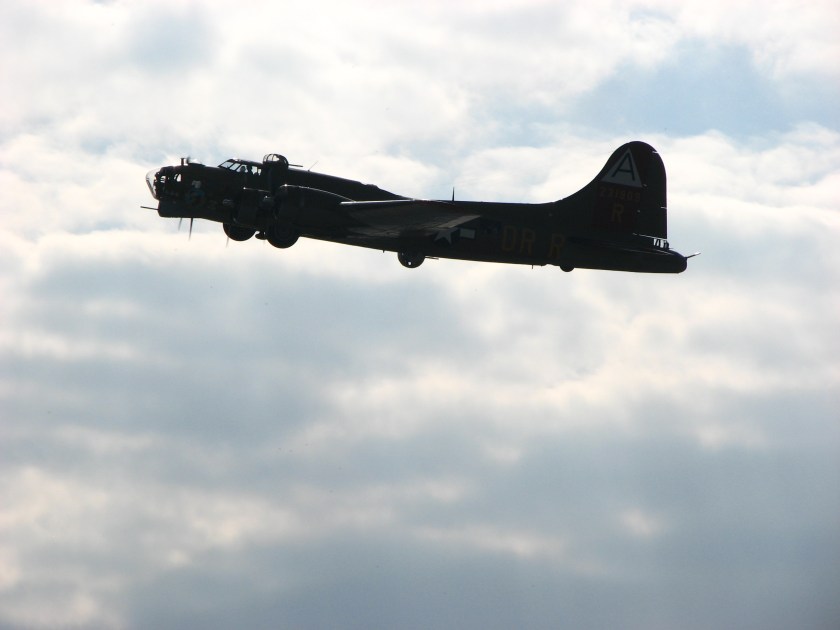
B-17G takes off from Love Field, Dallas, TX – 2007
December 20, 1943.
An American B-17F “Flying Fortress” bomber named Ye Olde Pub leaves Kimbolton, England on a daylight raid to bomb an aircraft factory on the outskirts of Bremen, Germany. It is one of 475 bombers on an 8th Air Force mission. Each bomber carries at least 3 tons of bombs and typically a ten-man crew.
While British bombers flew at night and conducted “saturation” bombings of large areas, the U.S. 8th Air Force conducted daylight, precision bombings. There were several reasons for this – increasing the effectiveness of each bomb by hitting specific targets; reducing collateral damage and civilian deaths; and around-the-clock bombing of the enemy. The price paid by both the Americans and the British was very high. The 8th Air Force alone suffered 47,000 casualties – 26,000 dead.
It was the first combat mission for Ye Olde Pub and its crew. It was also its last. But the end could have been far different.
As the bomber formations approached Bremen, they were pummeled by flak. (Flak, by the way, is derived from the German abbreviation FlaK, for Fliegerabwehrkanone which translates to “aircraft defense cannon.” No wonder they abbreviated it! It’s interesting how words enter our language.)
Ye Olde Pub was severely damaged by flak before reaching the drop point, but was able to bomb the target before turning for home. That was before German fighter aircraft attacked for the second time. Their first attack had been met by the friendly-fighter escort there to protect the bombers.
Bomber formations were designed to allow the bombers’ gunners to coordinate and concentrate their efforts to shoot any enemy fighter aircraft and thus protect the whole formation of bombers. The fighter escort was there to keep the enemy fighters even farther out and make it harder for them to get to the bombers. Additionally, they were to protect any bombers that could not maintain their position within the protective formation – stragglers. The problem with this particular mission was that the initial dogfighting had used enough of the fighter escorts’ fuel that they had to turn back before the mission was completed. Ye Olde Pub became a straggler due to its flak damage. The enemy fighters did what they always did – they pounced on the stragglers. Ye Old Pub was no exception.
In the fighting that followed, Ye Olde Pub flipped onto its back and plummeted toward earth. 2nd Lieutenant Charlie Brown, the pilot, managed to regain control, avoid crashing, and elude the enemy fighters as he approached the coast at low altitude. He knew there were more flak batteries that he must cross at the coast and low was better – until he flew right over an airfield that had just refueled and re-armed a Messerschmitt Bf-109 fighter. The Bf-109 pilot was German ace, Franz Stigler. He immediately took off to pursue the B-17 – and he caught it…
As Stigler approached, he realized something was wrong. The plane was so severely damaged he wasn’t sure how it could even fly – the nose was smashed, one of the four engines was out, half of the tail had been shot away, there was a huge hole in the fuselage and another in one wing. Further, the gunners didn’t fire at him. He was able to approach close enough that he could see the crew caring for each other’s wounds through the hole in the fuselage. Stigler decided to risk court-martial and possible execution for aiding the enemy and flew alongside the B-17. Stigler knew this action would prevent the coastal flak gunners from firing on the B-17 for fear of hitting him. As they went out over the water, Charlie Brown and his crew were certain he was just going to shoot them down anyway. Then they erroneously decided that he must be out of ammunition.
Stigler kept trying hand-signals. (Ye Olde Pub’s radio had been destroyed so they couldn’t have talked anyway.) Brown was sure he was trying to get them to turn back and bail out over Germany, but there were crew members who would not have survived that and they would all have become prisoners of war, so Brown kept the plane headed toward England. Stigler was actually trying to get them to fly to Sweden, a much closer, neutral country. After a few minutes, they saluted each other and parted company. Stigler headed back to Germany believing the B-17 would likely crash in the North Sea and wondering why he wouldn’t fly to the safety of Sweden. Brown continued toward England wondering if they would make it and why the German didn’t shoot them down. Both eventually wondered if the other survived the war.
Spoiler Alert
Ye Olde Pub did make it to England…barely. It was repaired and flew again, but never in combat, and was eventually scrapped. Most of the crew eventually flew the required number of combat missions.
* I would encourage anyone to read the book, A Higher Call, by Adam Makos. It is a great story about this encounter, what lead up to it, and the aftermath. Most of it is written from the perspective of Franz Stigler, but is an amazing insight into the wartime experiences of both pilots from beginning to end and beyond.
 CasualComments.com
Wow! I REALLY want to read that book now!
LikeLike
Love the picture too! 🙂
LikeLike