![20160429_122543[3]](https://casualcomments.com/wp-content/uploads/2016/05/20160429_1225433.jpg?w=840)
The Casual Comments Blog
Sitting here typing my blog entries on an Apple MacBook Air…
Sitting here typing my blog entries on an Apple MacBook Air…
(This post is a little longer than usual because of the topical importance and resulting need for more detailed background than normal.)
Pondering the protests in the streets following the election of Donald Trump as our next President, I’ve been confused about why the protests are being conducted. To say that he is “not my President” is a denial of fact. Whether or not one likes him or his potential policies, he will be the President of all U.S. citizens. To protest his policies, is to claim the ability to see into the future and know what will transpire over the next four to eight years. To protest over the outcome of the popular vote (which, as of this writing, is still not completed) versus the electoral vote is a fair protest. In reality, however, that protest is against the fact that the elections were legitimate and conducted in accordance with our Constitution. But there is much more to the story than that…
Let’s start with the premise that the United States is a democracy.
If you look at the definition, it isn’t. A democracy requires direct participation by all citizens. Even in the late 1700s, when the Constitution was proposed and adopted, that would have been unwieldy with a population estimated at 3.5-4.0 million. Even today, with our advanced data collection processes, it would be nearly unworkable. The U.S. was set up as a republic. A republic means that the power resides in those citizens eligible to vote for representatives to carry out their governmental business for them. From the very basic foundations of our Constitution, the United States was designed to be a representative form of government – it was never envisioned as a pure democracy.
Let’s look a little at the structure of Congress.
It was established with a couple of basic principles in mind – to give the ultimate power to the people, but to also limit the power of the majority. Talk about paradoxical goals!
The first part of the equation was simple – you have a House of Representatives (a.k.a. – “The Peoples’ House”) with a direct vote for a representative within their district. This makes the elected official both locally responsive and accountable. The problem, when you get these representatives together in the Capitol, is that they all have one vote. The drafters of the Constitution had already seen the failure of the Articles of Confederation where the states had too much power, but they couldn’t create a system where the states had no power. Had they left the House to itself, they would quickly face a “tyranny of the majority.” In other words, the states with the highest populations (which would give them the most representatives) would quickly dominate to their benefit and to the detriment of the lower-population states.
The Senate was established to give the states equal footing in one half of the Congress. In fact, as originally outlined in Article I, Section 3 of the Constitution, the state legislatures selected the two Senators who would represent the state. That was changed by the 17th Amendment and we, the people, now vote directly for the Senators as well as the Representatives. The difference being that where Representatives are locally accountable, Senators are accountable across the entire state.
What about the Executive Branch?
To save time and space, I’m not going to address the Vice-Presidential side of the structure since that position is now linked more directly with the Presidential selection. It is assumed (and indeed, we have probably been taught) that when we vote, we are voting directly for the President. The fact is, we have never voted directly for a President since the adoption of the Constitution. It has always been a vote for a group of electors from our state. If we were more diligent about reading and studying the actual language of the Constitution, the incorrect attributions and deletions would be recognized. In that sense, it is like the Bible! Fortunately, while it is almost as difficult to read, understand, and correctly interpret, the Constitution is a lot shorter!
Article II, Section 1 of the Constitution establishes the role of the Electors (and is modified by the 12th and 23rd Amendments). It also places some restrictions, but for the most part, the process by which electors are selected is controlled by the states – as it should be. Typically, it is left up to the political parties to select their electors which means they have a degree of loyalty to the party and the state and oftentimes are long-term party functionaries. It has happened, but for an elector to vote outside their party affiliation would be political suicide. Further, some states require they vote with the state’s majority selection by law.
So what is the value of the Electoral College?
Looking back to the previous discussion concerning the bicameralism of the Congressional structure, focus on the Senate. The purpose of the Electoral College is the same, but is now an ingenious application to the Executive Branch!
The whole idea is to, again, prevent the population majority from taking advantage of states with smaller populations.
In this recent election, some are saying that Sec. Clinton obviously would have won if it weren’t for the Electoral College. That is not a valid argument. When campaign strategies are planned, it is done with reality in mind, not “what if…” The Trump Campaign targeted the states needed to get the required electoral votes – not necessarily the population centers. The Clinton Campaign did the same. With an election this close, it is not possible to predict which candidate would have been the more successful in the other scenario. In fact, without the Electoral College, four states would largely determine who would win the presidency – California, New York, Florida, and Texas. Most other states would not have enough votes to justify more than a cursory visit by the candidates because the election would hinge on the four. It almost comes down to that now…
How would we get rid of the Electoral College?
Think about the basis for it. It would require an amendment to the Constitution to change the original document itself and the two amendments already addressing electors. The process is covered in Article V of the Constitution. An amendment may be proposed using one of two methods – two-thirds of both houses of Congress may propose an amendment, or two-thirds of the collective state legislatures may call for an Amendment Convention. Once it is proposed, it must be ratified to be put into effect. Three-fourths of the state legislatures (or three-fourths of the states’ Amendment Conventions) must ratify it. So, to sum up, 2/3 must propose it and 3/4 must ratify it. Interestingly, an amendment (even to make the election of the President a popular majority proposition) is never directly voted on by the people.
So, once an Amendment to do away with the Electoral College is worked out, it must still be ratified. Since 3/4 of 50 is 37-1/2, a majority would require 38 states. To block such an amendment would require 13 or more “nays.” When we consider the four largest states by their electors (which will give an easy comparison of relative populations), we have California with 55, Texas with 38, New York and Florida with 29 each. If we throw in Illinois and Pennsylvania with 20 each, those are the states that would most benefit from the removal of the College. There are 14 states with 5 or fewer electors. Those states would be the ones most “disenfranchised.” (That does not include the District of Columbia with only 3 electors – but no vote in the Amendment process since it is not a state.) If you add in the 20 states with 6 to 10 electors, it would not be difficult to find 13 from those 34 smaller states who are unwilling to become “second-class citizens” in the Presidential election process.
It is highly unlikely that an amendment to remove the College would be ratified.
So what is the purpose of these demonstrations and attempts to get electors to change their votes?
To be honest, they serve no purpose other than a way to vent frustration at an election that didn’t yield the protestors’ desired results. That’s fine as long as there is no violence, no destruction of property, no harassment, and no disruption of critical services (like blocking passage of an ambulance on an emergency run) – but I think there are better ways to waste time…
We all have friends or acquaintances who are seemingly addicted to having the “latest and greatest” as soon as it hits the market. We also all know that new products often have issues that take a while to get straightened out. It’s a universal problem with which regular consumers and even governmental entities contend. Look at the issues surrounding development and acquisition of the F-111 aircraft. Consider the M-1 Abrams tank’s initial deployment problems, and more recently, the Bell Helicopter V-22 Osprey. All of them had difficulties before they were straightened out.
So embracing new products, especially where technological limits are being stretched, is a risky proposition. Some troubled new products become long-term successes…others, not so much. I almost never purchase a newly released product for that reason. I always like to wait a little while to allow for the “bugs” to be worked out. I had to insert “almost” because of a recent decision.
Enter the Samsung Galaxy Note 7 smart phone…
I really liked my Note 3 phone. I would have been very content to continue to use it for a couple more years. I was impressed with the Note 4, and totally turned off by the Note 5 (another story altogether). I was so put off by the Note 5, I was resigned to the possibility that my Note 3 would be my last Samsung phone. When the ads started appearing for the Note 7, I realized they had corrected some of the issues I had with the Note 5 and curiosity led me to look more closely at the 7.
I liked what I saw in the 7’s capabilities and decided I would wait six months and get one, even though I really hated to set the 3 aside. Then, Samsung sweetened the deal – you could get a smart watch or a 256GB micro-SD card thrown in. The only problem was it had a time limit. So I went down to the local AT&T store to order the phone, not knowing when it would actually be available. The gentleman at the store told me I could order it that day and have it within a week…but if I came in the next day, I could pick one up because it was being released then. So, I thought, “Why not…?”
I showed up the next day and bought the Note 7. It was all I had hoped it would be! It had all of the capabilities of the Note 3 (except a user-replaceable battery) and every feature was significantly improved. I could live with the trade-off of the permanent battery for the dust and water-resistance features. It was basically the phone I’ve always wanted, but it had taken decades for the technology to get there!
Then came some scattered reports of the things catching fire or exploding. That is a definite risk with any Lithium-Ion batteries. Owners were being told to bring them in and get another type of phone. I calculated my risks based on sales and number of fires as being significantly less than 0.03%, or less than a 1 in 40,000+, chance of a problem. I wasn’t trading it for a lesser phone.
It didn’t take too long before Samsung put out the replacement Note 7. I still wasn’t thrilled because it takes so much time and effort to set up and personalize a new phone. I didn’t rush down, but I did decide to swap it out. Since I had taken my time swapping the phones, I had only used my second Note 7 for a week or so when reports of the replacement phones catching fire began. Soon, owners were being offered the opportunity to trade them for a different phone. I decided I’d consider the offer, but would probably just keep the new phone…
Then the FAA banned carrying or storing the Note 7 on a flight – with the potential of a $180,000 fine! Then Amtrak banned the phones. Then, Samsung announced they were discontinuing production. Everybody knows what that implies – no support, no repair, no software updates, and the potential for a system update that just completely shuts down the phone for safety’s sake! So here I sit with my new Samsung Galaxy S7 Active laying on the desk in front of me.
I learned my lesson concerning the early adoption of new products and technology! It shouldn’t be too difficult to have the patience to wait until the initial issues are resolved, since that’s what I’ve practiced most of my life. And, the S7 Active is a very good phone! Rumor has it that while a replacement/upgrade of the Note 7 is coming, the “Note” name may be dropped due to the stigma attached.
In the meantime, I am reading the blogs and news concerning when the Note 8 (or whatever it’s called) is going to be released…and counting the days…

A 1970 John Wyer/Gulf Porsche 917K (chassis # 917-013) in 2006. Photo by Brian Nelson from Hockley, Essex, England
The 24 hours of Le Mans, 1970.
An odd car was entered into the race and completed 282 laps – quite an accomplishment considering it was underpowered compared to most other competitors, was carrying additional weight, and its aerodynamics were dramatically impacted by the added objects. The car was a Porsche 908/02 owned by the actor, Steve McQueen. What made it less competitive were the cameras it carried. It was the camera car to obtain film footage of the actual race for a movie coming out in 1971. It not only had to make the regular pit-stops, but also additional ones to load more film. It still finished in 9th place. (By the way, Porsche is a two-syllable word – pronounced close to ‘porsh-eh’, where the sound is like a mix of a short ‘e’ and ‘uh’, but certainly not ‘porsh’…)
In June, 1971, the movie, Le Mans, was released in the U.S. It was a fictionalized film about the race and one of its drivers (played by Steve McQueen). It also starred the Porsche 917. Specifically, the 917K (for Kurzheck – ‘short tail’). The 917K was the culmination of development and testing by the John Wyer Gulf Racing Team. The original long-tailed 917L (Langheck) was more teardrop shaped with smoother aerodynamics giving it a lower drag coefficient. It was a great machine for acceleration with its flat, air-cooled, 12-cylinder engine, but it was a handful to drive. It was considered dangerous by many who drove it because it was so unstable at high speed. By shortening the tail and raising it to create more down-force (but also increasing drag), the car became a little more wedge-shaped and much more stable. The increased drag was not a problem. That 4.5-liter 12-cylinder engine developed 520 horsepower in a car that weighed under 2000 lbs. For comparison, a current Ford Taurus weighs between 3900 and 4400 pounds and has a maximum of 365 horsepower. It could accelerate from 0-60 mph in 2.5 seconds and had a top speed of about 250 mph – the Porsche, not the Ford!
(As a side note – the open-top 917/30 used in the 1973 Can-Am races had a 5.4-liter engine with twin-turbochargers. It literally had an adjustment nicknamed the “horsepower screw” with which the turbo boost pressure could be adjusted up or down depending on the needs dictated by the race track conditions. At low pressure, the engine developed only 1100 horsepower…at high pressure, it reached 1580 horsepower – in a car weighing 1800 pounds!)
The Porsche 917K used in the movie (chassis # 917-024) was owned by Jo Siffert and leased by the production company. For the movie, it was painted in the light blue and orange colors of John Wyer’s Gulf Oil Racing Team. (As mentioned in a previous post, my own Porsche was the same Crystal Blue color.) During filming, the engine was damaged and to locate a replacement, they contacted the Porsche factory. Porsche was going to get some publicity from this film, so they were happy to loan the filmmakers an engine – but it had to be returned as soon as possible because they needed it. The filming finished, the engine was removed and returned to Porsche, and the car…disappeared…
In 2002, in a barn outside of Paris, the car finally turned up. It had been sold to a French enthusiast and had apparently been housed there collecting dust the whole time. It was sitting largely undamaged on the now rock-hard Firestone racing tires from the 1970s, despite the Goodyear sticker on the nose. The damage was done by a family of mice who had taken up residence and chewed up the electrical system. How and why it was parked and left are the questions, but it is considered the most original 917 left in the world. All of the other 917s have been wrecked and repaired, cannibalized, or scrapped. Another oddity – when last seen, in the movie, the car was marked with the number 22, but mysteriously, when discovered, it had the number 65 on it. Why? And where did that Goodyear logo come from and why was it stuck on there? The car still had no engine, but as restoration began, one was located in the U.S. The efforts may have concluded now, but the car was still undergoing restoration in 2014. No expense has been spared in making this car as original as possible.
It has got to be one of the most amazing barn finds ever!

The “Number 22” Porsche 917K during filming. Photographer unknown.
There are a number of levels of security classification. The higher the level of classification given to information, the higher the level of clearance required to see it and the higher the risk of damage if the information is disclosed.
When an individual is granted a security clearance, all of the information classified at that level is not shared with that person. It is compartmentalized and handled on a “need-to-know” basis – if they don’t need to know it, they won’t see it! In fact, clearances are usually downgraded when the individual is no longer working with the more highly classified information.
The procedures vary and I won’t get into that, but some things are common – an initial briefing, periodic briefings that reiterate the salient points of the initial briefing, and then an exit briefing. All of these briefings discuss the proper procedures for the handling of classified material and the potential consequences to you (if you’re the one being granted a clearance), your compadres, your family, and the country if the information is compromised. The consequences can be wide-ranging – everything from the destruction of the country, your death, or the deaths of other individuals (singly or on a large scale). The potential consequences for mishandling that information are also covered – criminal prosecution, jail, or execution in extreme circumstances. These are not briefings easily forgotten – partially because they are structured to reinforce their critical nature!
When your life and the lives of those around you are in the balance, you take security and classified material very seriously. Unless the proper protocols are followed, having unsecured classified information in your possession, risks compromising that material. Intent has no bearing! It is black or white – either it is secured or it isn’t. This is particularly true of electronic platforms because they are often easily hacked. It is also imperative to know if and/or when that information is compromised. When trying to determine if that data is erased, or wiped clean, it certainly deserves something other than a flippant, “Like with a rag…?”
The trigger for this post was the 3rd Presidential Debate – not the debate itself, but a statement made in the debate. Hillary Clinton stated as fact, that the response time for nuclear weapons is four minutes. I spent over 28 years in the US Army and I worked with nuclear weapons during part of that time and I don’t know if that is an accurate statement or not. I was not dealing with response times. I did not have a “need-to-know” and quite honestly, I didn’t want to know! My questions now become, is that information accurate, and did the whole world need to know that?
Military commanders do their best to get inside the decision cycle of their adversaries. There is a major advantage to knowing the timeline of their cycle because a commander can insert himself and the forces at his disposal to disrupt their decision-making ability. According to Mrs. Clinton, there is a four-minute window in which to compromise our national defenses. Again, if accurate, that is information I would only want those with a true need to know to possess.
As the election approaches, we have four choices. I will rule out the two third parties simply because there is no chance that either will win, and even if they do, they will be fighting both the Republicans and the Democrats in Congress. With a degree in Political Science, I can tell you – that is a recipe for gridlock like we’ve not seen. So that leaves two viable candidates.
I will state up front, Donald Trump is not my first choice for President. I do not like some of the things he has said which indicate some character flaws. Hillary Clinton, on the other hand, also has some serious character flaws that I won’t get into at the moment.
So, who to vote for…?
First, to not vote is an abdication of personal responsibility for the future of this country and even the world. Second, to vote for someone who has no chance to win is, in effect, the same. If it is in protest, it will not get the attention of the major parties. (It is like spitting into the wind – the only one who notices and suffers the consequences is the one doing the spitting.) The net result of either of those options is the same – the future is determined by the vote of someone else.
A recent television ad highlights a former missile launch officer talking about when the order comes down to launch, the missile is launched. He goes on to say that he wouldn’t want Trump to make that decision. Obviously, Hillary Clinton approved that ad.
So again, who to vote for…?
What isn’t stated in the ad is that this officer alone cannot launch a missile. It requires additional personnel – to include a second launch officer acting in concert with the first. Further, he knows that, likewise, an order to launch is not made in a vacuum at the sole whim of the President. It is a deliberate act with many “moving parts” and fail-safes. The possible exception is the response to an imminent attack – and even then, within the “four-minute window” and beyond, the fail-safes are still in play.
While I have deep suspicions about the women coming forward to accuse Trump of unwanted advances, even if true, they do not directly compromise the security of this nation, nor endanger the lives of those who serve to protect us.
I will state that I cannot – I will not – vote for someone who has casually put our country, our servicemen, and others at great risk – intentionally or not! By her actions and cavalier approach to security, Hillary Clinton has already shown that she does not respect the lives and sacrifices of those of us who have answered the call to potentially put our lives on the line to serve our great nation! What could her future actions entail?
Trump may be temperamental and blusterous, but he has not compromised the safety of this nation through his actions, his email nor his speech. I see no other option for our security and the future of our country – I will vote for Mr. Trump and strongly urge you to do the same!
Clarence and Nita lived in Lebanon while he was a missionary. Many times I remember him praising the hospitality afforded to guests by the Lebanese people. It is not only a local or national cultural characteristic, but extends through much of the region. My family experienced it during our time in Turkey. I don’t know if my in-laws were raised that way, learned it in the Middle East, or adopted it afterward, but they were the consummate hosts when anyone came into their house. I just know that from the time I first met them until Clarence passed away and Nita moved in with one of their sons, they treated everybody as greatly honored special guests. That even extended to the young guy dating their oldest daughter, who eventually became a son-in-law…
I don’t remember when I started drinking coffee, but I do know I drank a LOT of it during my college years. I still drink quite a bit of coffee, and love my Keurig – it makes a consistently good cup of coffee.
This story takes place after Vonna and I had been married a number of years. We were at Clarence and Nita’s house the day after their return from a week-long stay at a cabin in the mountains of New Mexico. As Clarence and I sat in the living room talking, Nita asked if we wanted some coffee. We both said we did and she went back to the kitchen, where she and Vonna were talking, to put on the coffee. Not long afterward, Nita came back carrying mugs of coffee for us. It wasn’t necessary, but as I mentioned, being hospitable was always important to them.
Clarence and I differed on how we liked our coffee. He liked his so hot it wouldn’t have cooled a nuclear reactor. He also preferred his coffee black. I, on the other hand, like my coffee hot, yet cool enough that my taste buds don’t take days to recover. And while I also like black coffee, my preference is with some cream and sugar. Vonna and I had been married long enough, and Nita was observant enough to know exactly how much cream and sugar I liked in my coffee. So for years, whenever she had offered me a cup of coffee, she served it with those condiments stirred in. And it was always a great cup of coffee!
It has finally been resolved, but for decades Amarillo had issues with the salt content of the city water. At the time of this story, it was dramatically improved, but ice made from the city water still needed rinsing to remove the slight amount of salt forced to the outside by the freezing process before putting it in a drink. Cups and glasses, after being rinsed and allowed to dry upside down would sometimes have a slight salt taste when you first put the rim to your lips. So I thought nothing of it when I put the cup of coffee to my lips. Slight salt taste, no big deal. The temperature was just right for a large sip of the liquid…
As I brought it into my mouth, my expression must have changed dramatically. Clarence looked over at me and smiling, asked, “What’s the matter? Too hot for you?” I couldn’t answer, I had a mouth full of coffee. But it was unlike any coffee I had ever tasted! As I sat there, my face getting more and more red, I couldn’t decide whether to swallow it or spit it back into the cup! I finally decided on the latter action. Then I could respond to him and Nita, who, hearing his question had come back into the room. It was extremely salty! It took just a minute for Nita to figure out what had happened. When they had gone to the cabin, she had put several things in similar jars – flour, sugar, and SALT, among other things. Since they had just returned home, she was using the items she needed from the jars rather than the regular canisters. Unfortunately, the salt and sugar looked very similar and being distracted by the conversation with her daughter, she confused the two jars. I’m just glad it wasn’t something like detergent!
Apologizing profusely, as we all laughed about it, she brought a tray with a fresh cup of coffee, a spoon, sugar bowl and cream. I “doctored” my own coffee. To this day, over 30 years later, she has never again put cream and sugar in a cup of coffee for me…
In a previous post, I described a near-accident in a Porsche and how its extraordinary capabilities both got me into and out of trouble. It is the blessing and curse of driving a high-performance car and not paying attention to or respecting that fact. I also mentioned there was another incident in that car where I believe it saved my life or at least prevented serious injury.
I was headed from Amarillo to the city of Canyon, 19 miles away, for a fraternity gathering. It was 10:00 on a Friday night and I was running late…
I had made that trip many times and knew the roads very well. Just south of the city limits of Amarillo, I was on a familiar, but very lightly traveled country road. I was observing the 65 mph speed limit before rounding a curve onto a long, straight stretch with a slight drop before a small incline in the middle of that stretch. To make up some time, I increased my speed…to 110. With my halogen lights on, I could see fairly well, but quite honestly, not for that speed. Then, way off in the distance, I saw the taillights of a car ahead.
“Knowing my luck, that’s a cop…” I backed off of the accelerator some. I was now heading into that slight down slope so my headlights were shining onto the road, not parallel to it because of the beginning of the slight upslope. My distance vision was radically reduced.
“What was that?” I thought I saw a small flash in front of me. I moved my foot from the accelerator to the brake. I reached the bottom of the slope at about 95. When the headlights were shining parallel to the road again, I saw them! The flash had been the reflection of my headlights in a cow’s eyes!
Two black steers were walking head-to-tail across this narrow road. It was blocked! I hit the brakes hard but was so close I was upon the cows going somewhere between 70 and 80. I couldn’t go off road and around them at that speed, so I took my only option – go between them. Great idea, but the space was smaller than the width of the Porsche.
I hit the front leg of the second cow, then I felt it hit the side of the car and things got squirrely. The car headed left, so I cranked the steering wheel back to the right. The car got a little sideways pointed to the right and as I looked out across the grass on that side of the road, it looked flat, but there was a barbed wire fence probably 20 yards away. I remember thinking, “If I go off the road here, at least it’s flat. But I might hit that fence…” I twisted the steering wheel back to the left then adjusted to the right. The car fishtailed, straightened up and I pulled it off the road.
“There’s a dead cow in the road…I need to get it off the road before somebody else hits it!” I tried to open the driver’s door – no luck. I crawled over the shifter to the passenger seat, opened the door and stepped out. I walked around the front and looked at the u-shaped dent in the bumper. Then I looked at the completely collapsed left front fender that was shoved back against the door wedging it shut. As I walked to the back and saw the dent in the left rear fender, it was beginning to register that even if there is a cow on the road, I’m not going to be able to drag over a thousand pounds of literally dead weight off the pavement. But I did want to see if the cow survived. It was nowhere to be found! I knew he couldn’t have gone far because the dent in the bumper said his leg must be broken…
I walked to a nearby farmhouse and called the Department of Public Safety. When they arrived, they agreed that the cow couldn’t have gone far. Shining their spotlights at the fence, they noted that the fence was down. Texas is not an open-range state, so the cows were definitely guilty of jaywalking.
When they finally located the cow, it was dead. Its neck was broken. It was lying in a ditch hidden by tall grass on the left side of the road. When they were finished, they told me I could drive the car home. There was only one problem. By then, my father had come to pick me up and using a crowbar, we couldn’t bend the metal fender off of the left front wheel enough for me to turn the steering wheel more than an inch in either direction!
Saturday was very sobering intellectually and emotionally. I went back to the scene of the crime. On the left side of the road was the hidden ditch where we found the cow, but on the other side of the road, was another hidden ditch about 10 feet wide with a 6-foot drop-off. Based on the skid marks, it was where I thought the ground to the right was flat. It would have been much worse had I gone off the road there! At that point during the accident, I remember turning the steering wheel through more than 90-degrees in each direction from center. Afterward, I couldn’t move it more than about 10-degrees because of the fender collapsed around the wheel.
The car was back on the road in three weeks – a testament to Porsche’s engineering and construction quality. I have no good explanation why the steering wheel turned so easily during the accident and almost not at all afterward…other than to say that my faith that God has a plan for me was strengthened.
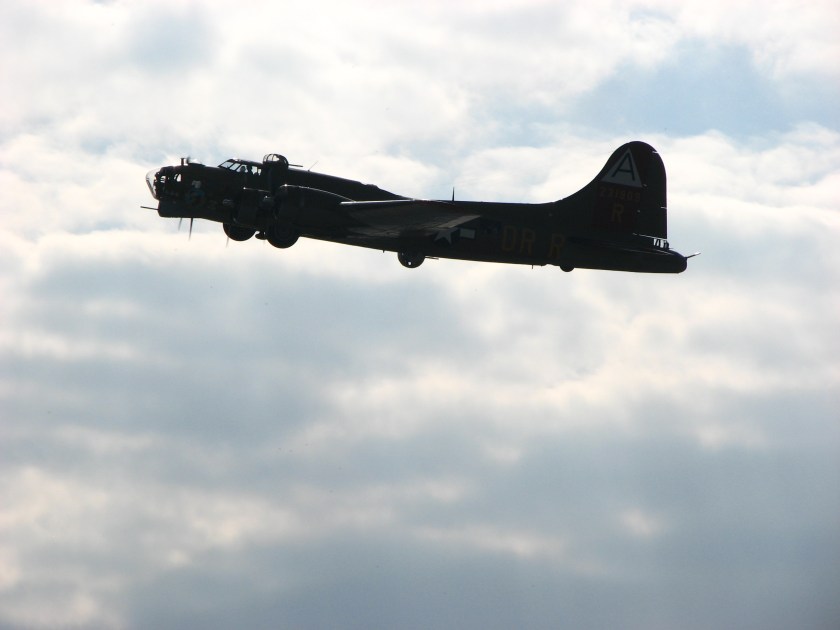
December 20, 1943.
An American B-17F “Flying Fortress” bomber named Ye Olde Pub leaves Kimbolton, England on a daylight raid to bomb an aircraft factory on the outskirts of Bremen, Germany. It is one of 475 bombers on an 8th Air Force mission. Each bomber carries at least 3 tons of bombs and typically a ten-man crew.
While British bombers flew at night and conducted “saturation” bombings of large areas, the U.S. 8th Air Force conducted daylight, precision bombings. There were several reasons for this – increasing the effectiveness of each bomb by hitting specific targets; reducing collateral damage and civilian deaths; and around-the-clock bombing of the enemy. The price paid by both the Americans and the British was very high. The 8th Air Force alone suffered 47,000 casualties – 26,000 dead.
It was the first combat mission for Ye Olde Pub and its crew. It was also its last. But the end could have been far different.
As the bomber formations approached Bremen, they were pummeled by flak. (Flak, by the way, is derived from the German abbreviation FlaK, for Fliegerabwehrkanone which translates to “aircraft defense cannon.” No wonder they abbreviated it! It’s interesting how words enter our language.)
Ye Olde Pub was severely damaged by flak before reaching the drop point, but was able to bomb the target before turning for home. That was before German fighter aircraft attacked for the second time. Their first attack had been met by the friendly-fighter escort there to protect the bombers.
Bomber formations were designed to allow the bombers’ gunners to coordinate and concentrate their efforts to shoot any enemy fighter aircraft and thus protect the whole formation of bombers. The fighter escort was there to keep the enemy fighters even farther out and make it harder for them to get to the bombers. Additionally, they were to protect any bombers that could not maintain their position within the protective formation – stragglers. The problem with this particular mission was that the initial dogfighting had used enough of the fighter escorts’ fuel that they had to turn back before the mission was completed. Ye Olde Pub became a straggler due to its flak damage. The enemy fighters did what they always did – they pounced on the stragglers. Ye Old Pub was no exception.
In the fighting that followed, Ye Olde Pub flipped onto its back and plummeted toward earth. 2nd Lieutenant Charlie Brown, the pilot, managed to regain control, avoid crashing, and elude the enemy fighters as he approached the coast at low altitude. He knew there were more flak batteries that he must cross at the coast and low was better – until he flew right over an airfield that had just refueled and re-armed a Messerschmitt Bf-109 fighter. The Bf-109 pilot was German ace, Franz Stigler. He immediately took off to pursue the B-17 – and he caught it…
As Stigler approached, he realized something was wrong. The plane was so severely damaged he wasn’t sure how it could even fly – the nose was smashed, one of the four engines was out, half of the tail had been shot away, there was a huge hole in the fuselage and another in one wing. Further, the gunners didn’t fire at him. He was able to approach close enough that he could see the crew caring for each other’s wounds through the hole in the fuselage. Stigler decided to risk court-martial and possible execution for aiding the enemy and flew alongside the B-17. Stigler knew this action would prevent the coastal flak gunners from firing on the B-17 for fear of hitting him. As they went out over the water, Charlie Brown and his crew were certain he was just going to shoot them down anyway. Then they erroneously decided that he must be out of ammunition.
Stigler kept trying hand-signals. (Ye Olde Pub’s radio had been destroyed so they couldn’t have talked anyway.) Brown was sure he was trying to get them to turn back and bail out over Germany, but there were crew members who would not have survived that and they would all have become prisoners of war, so Brown kept the plane headed toward England. Stigler was actually trying to get them to fly to Sweden, a much closer, neutral country. After a few minutes, they saluted each other and parted company. Stigler headed back to Germany believing the B-17 would likely crash in the North Sea and wondering why he wouldn’t fly to the safety of Sweden. Brown continued toward England wondering if they would make it and why the German didn’t shoot them down. Both eventually wondered if the other survived the war.
Spoiler Alert
Ye Olde Pub did make it to England…barely. It was repaired and flew again, but never in combat, and was eventually scrapped. Most of the crew eventually flew the required number of combat missions.
* I would encourage anyone to read the book, A Higher Call, by Adam Makos. It is a great story about this encounter, what lead up to it, and the aftermath. Most of it is written from the perspective of Franz Stigler, but is an amazing insight into the wartime experiences of both pilots from beginning to end and beyond.
At a very young age, my parents instilled in me a love for reading. While I’ve mentioned that there were many trade-offs of growing up as a military dependent, reading only recently occurred to me. We moved a number of times during my formative years and had no permanent home. I spent more than half of my first 15 years in Europe.
Television was not new, but it was expensive and not deemed necessary by the Department of Defense, so while they would ship one of those old, heavy, fragile sets, the choice of stations was very limited. In West Germany, you could watch TV, but it was all “auf Deutsch” (in German) and limited to a couple of stations. Admittedly, watching “Mr. Ed” speak German to Wilbur was rather entertaining! So listening to records (those round, flat, literally groovy things that preceded CDs), to AFN (Armed Forces Network) radio, going to the US military movie theaters, and reading, were the entertainment sources. The military did provide well-stocked libraries.
The concept of a personal library also wasn’t new – we just couldn’t afford the weight involved. The military limits the weight of “household goods” they will ship depending upon several factors. Beyond that, you pay for the shipments, so things like furniture, clothing and cookware take priority. Even though they store what isn’t shipped, there are weight limits to that as well. The one thing that a lot of military families shipped, in terms of books, was a set of encyclopedias just in case their new assignment didn’t have a good, convenient library.
A number of years ago, I developed a friendship with a missionary, William. He was maybe 10 years older than me, so their children were grown and on their own. William traveled around the country preaching and raising money for the work with his wife, Ginny. Over the years, they had several large travel trailers towed by a big pickup truck. They would park in one place for a couple of months and visit a number of churches within a reasonable driving distance. They would then return a couple of years later to give progress reports. Like most preachers, William felt that he needed a good set of reference books. Initially, he stored a few hundred pounds of them in waterproof containers in the bed of the pickup under the camper shell – before they bought a 5th-wheel trailer.
One of the things we had in common was the use of Macintosh computers. He kept sermons, notes, writings and some reference materials on his Mac. At my urging, he began to explore scanning and digitizing his reference materials to save weight and prevent potential damage to some of his rare, out-of-print books. Several years later, as scanners dropped in price, he had put most of the physical library into secure storage. Back then, his digital storage options were CDs, diskettes, and hard drives. Unfortunately, before the advent of high-capacity flash drives and micro-SD cards, he succumbed to esophageal cancer and I lost a good friend…
When I travel, especially for more than a day or two, I like to have a good source of reading materials. As a result, I have put much into my phone, tablet and notebook computer memory. In addition, even more is onto flash drives and especially, micro-SD cards. It is amazing how extensive your “library” can be on just one or two cards – and you can easily have multiple backups.
My preference is Adobe Acrobat (.pdf) format. The reason is simple – it is about as universal as it gets for materials that include more than plain text. I settled on that almost exclusively after having a bad experience with a source that uses a proprietary format. (I do use Nook and Kindle, but very circumspectly – even though they were not the problem company.)
For years there has also been a push to keep your library in “the cloud” for access by any device from anywhere – but I remain a little skeptical. In my younger days I could go to the library on base and check out a book. But when we were re-assigned, it had to be returned whether or not I was still reading it. Of course, when we got settled at our new location, often nearly two months later, I could usually check out another copy of the same book and finish it, but they were not always available. I also couldn’t read it during the travel time. Currently experiencing some kind of complete internet blackout at my house makes it even more similar – no television, no home phone, and no access to anything I have stored in the cloud. Well, I can go 4G, but I don’t have unlimited data so “shipping” that library becomes too “heavy” and thus expensive. I’m glad my personal digital library is stored on personal media. I can afford to ship that…
A few days ago, my daughter’s car was parked behind mine in our driveway. As she moved her car while I backed out, I noticed that one of the headlights of her car was not working. Obviously, that would need repair before dark if possible. A little bit later, we swapped vehicles, leaving me the cyclopean car.
Working on cars is not like it used to be. In my younger days, I didn’t hesitate to tackle any maintenance job – rebuilding the engine in my parents’ old station wagon, replacing the clutch in my Porsche, rebuilding the disc brakes of my SAAB 900 Turbo, and so on… The automobile manufacturers have not cooperated, however, and it has become increasingly difficult to do even the simplest things. I pulled up a YouTube “How To…” video showing the necessary steps to replace the headlight bulb on a Ford. Amazingly, it can be done without the full resources of a dedicated auto rebuild facility. I opened the hood and in two minutes was holding the dead bulb. I headed to the nearby parts store confident that this was not going to require a second mortgage to pay for the repair. I was right! The new bulb was less than $40 – but still an outrageous price for a light bulb.
After paying for the parts, I walked out and decided to do something that is very unusual for me. Normally, I would go home to make the repair, but this was such a simple job, I would just raise the hood and install the bulb before I left. I opened the car door, removed the bulb from its packaging, applied the silicone grease, and opened the hood.
As I bent over the engine of the Ford to replace the bulb, I had just stopped moving when I heard a flapping noise to my left and behind me. I turned my head in that direction and caught just a glimpse of shiny black movement. As I turned my head back toward the engine, I felt it…a large bird had just landed on my back! I have no idea what he was thinking because I was definitely a moving landing site! I was not sure if he thought he could pick me up and carry me away, if he had been influenced by Alfred Hitchcock’s “The Birds” or if he thought I was a pirate and he was my parrot. I was not comfortable with this arrangement no matter what his thinking! Not to mention that he was distracting and I was busy. I tried to reach back and brush him off – he just hopped farther up toward my shoulders. I quickly twisted and raised up. That got his attention and he apparently decided my back was not sufficiently stable after all. I heard more flapping, felt the weight lift and caught a glimpse of black wings heading off to my right side…
I straightened up, but he was gone. I don’t know what type of bird he was – he was big enough to be a medium-sized crow. At least he didn’t claw or peck. Fortunately, he also didn’t leave a messy reminder of his visit!
I don’t know what he was thinking, but I do know this – even simple car repairs now have new and unexpected consequences, delays and risks…and I REALLY don’t like somebody looking over my shoulder while I work!
That is especially true when there is no possibility of “correcting” that attitude!
I was heading out of town on a business trip a couple of years ago. I traveled a fair amount back then and had the routine pretty well down. But this particular day, I had been a little delayed getting out of my house and on the road to DFW Airport. I don’t live far from the airport so it wasn’t like I had to drive for an hour to get there. But if you’re running late, you are running late and the flight is missed whether near or far…
Having flown out of DFW a number of times, there was an offsite parking garage that I used frequently…The Parking Spot II. They are not far from the American Airlines terminals I use and provide a shuttle bus. As I approached DFW, the traffic slowed and the GPS in my car warned of delays due to an accident. (I often use GPS for a reasonably accurate ETA even when I know exactly where I’m going – just ask my wife.) There were already known road construction delays on that route, so I made a decision – follow the GPS-recommended route to the garage.
At the time, it seemed like a rational decision with the GPS-predicted delays. I tapped the screen to accept the recommendation, and was told to take the next exit a hundred yards distant. I did, and all was well! My new ETA was more palatable even though I was still running behind my preferred arrival time. I almost invariably arrive well before the scheduled departure time to allow for delays and, for me, it was cutting it uncomfortably close.
After a few minutes, the GPS told me to take the next exit from this alternate highway. I took one look at the exit and the surrounding area. GPS was telling me I was almost at my destination. It didn’t look right, so I overrode the GPS recommendations. It could re-calculate. Instead, it insisted on sending me back to that intersection. I exited about a mile farther down the road.
Not trusting the GPS at this point, I pulled into a parking lot, tapped the button on my iPhone and said, “Siri. Directions to the Parking Spot II.”
Siri – “There are two Parking Spots nearby. Which one do you want?”
I looked at the addresses, which really meant nothing to me, especially since Siri identified both as “Parking Spot,” nothing more. So I said – mostly to myself, “I don’t know…”
That’s when Siri’s attitude came out. “Well…nobody knows everything! End of call.”
WHAT?!! I DON’T HAVE TIME FOR THIS!!
I couldn’t believe ‘she’ had hung up on me – possibly my biggest pet peeve! I demanded directions from Siri again. But this time, having noticed phone numbers below the addresses, I called the closer site. I’ll show ‘her’ who’s the boss!
When I got a live person, I confirmed that this was “The Parking Spot II,” gave my location to the lady and got the directions from her! (I don’t normally admit this, but the GPS had been right all along.)
I was uncomfortably later than planned, but still well ahead of the flight time – no thanks to Siri! (Honestly, it’s a great app and I admire whoever programmed it…and their sense of humor!)
 CasualComments.com